- Joined
- 20/7/24
- Bài viết
- 4,619
- Reaction score
- 0
- Points
- 36
Scenes of Northern Vietnamese Life in the Watercolors of Thang Trần Phềnh
Thang Trần Phềnh (1895–1973) was one of the early generations of Vietnamese artists associated with the development of modern Vietnamese art and the École des Beaux-Arts de l’Indochine (Indochina College of Fine Arts). He was known for works depicting Vietnamese culture, history, and everyday life. Particularly notable are his paintings documenting traditional customs, clothing, and social activities in Vietnam.
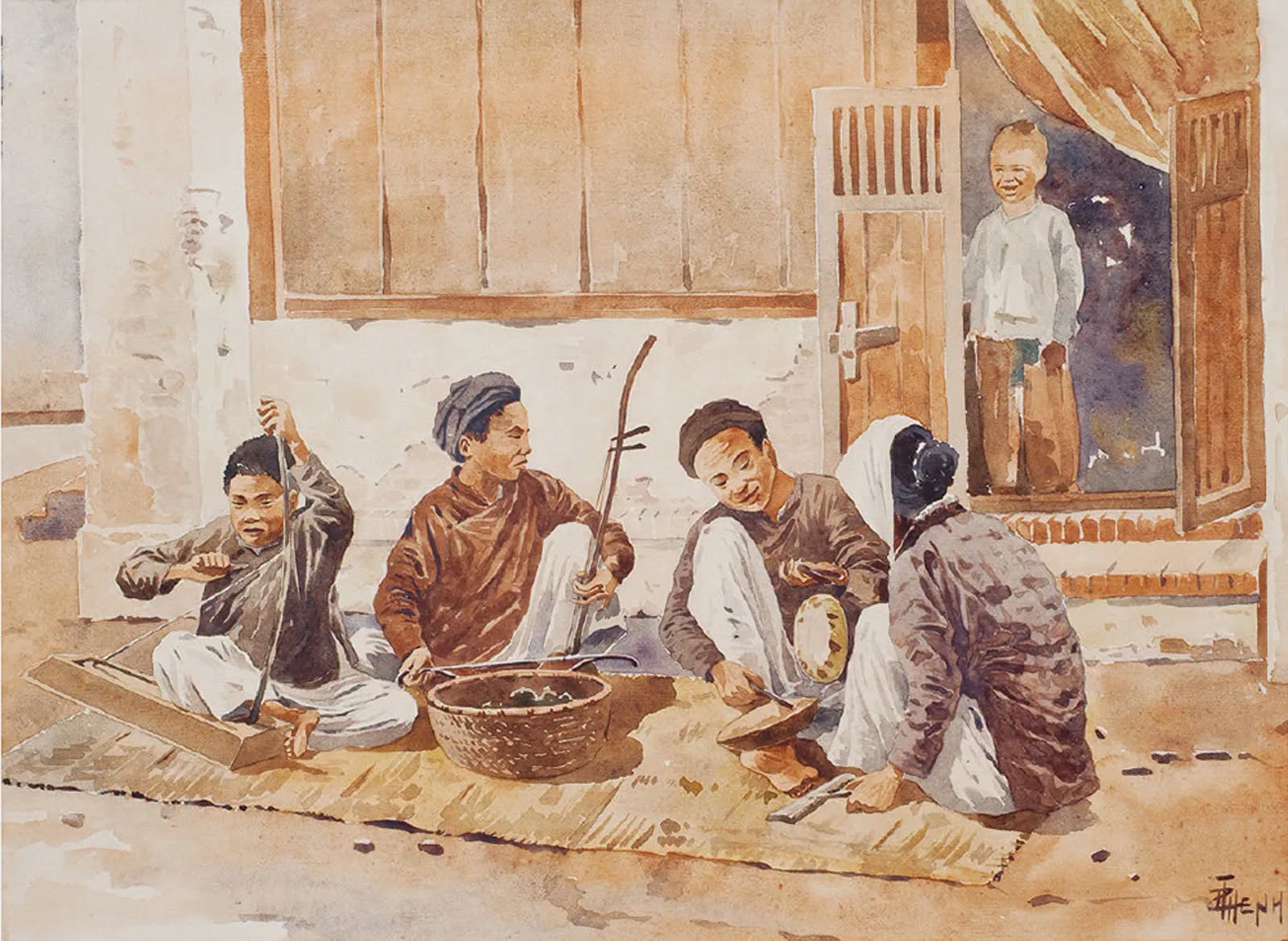
The series of nine watercolors titled Scenes of Old Vietnam represents an important part of Thang Trần Phềnh’s artistic legacy. Through the medium of watercolor, the artist reconstructed familiar scenes of daily life in northern Vietnam before the profound transformations brought about by modernization. These works possess not only artistic value but also considerable significance as visual records of Vietnamese society, customs, and cultural practices during a historical period that has since disappeared.
In these paintings, everyday life occupies a central position. People appear within familiar settings of northern villages and towns, wearing traditional clothing and participating in activities characteristic of Vietnamese society at the time. Details such as garments, headwear, household objects, means of transportation, architecture, and the arrangement of public spaces contribute to a vivid representation of traditional Vietnamese life.
The use of watercolor gives the series a distinctive visual quality. Unlike oil painting, which allows for strong modeling and rich tonal contrasts, watercolor enables Thang Trần Phềnh to work with delicate, transparent, and fluid areas of color. His figures and surroundings are rendered with relatively economical brushwork while retaining the essential details needed to establish their identity and context. This approach allows the paintings to function simultaneously as artistic compositions and visual records.
An important aspect of Thang Trần Phềnh’s work is that he was not concerned solely with the aesthetic appearance of landscapes or figures. He also focused on the cultural dimensions of everyday life. Ordinary activities became subjects worthy of artistic observation. Through these scenes, he documented a Vietnamese society undergoing profound cultural, economic, and social changes under the influence of modernization.
Within the history of Vietnamese art, Thang Trần Phềnh occupies a noteworthy position because his career developed during a period of transition between traditional Vietnamese artistic practices and modern Western-influenced art. Artists of his generation did not necessarily abandon indigenous cultural heritage. Instead, many sought to reinterpret Vietnamese subjects through new artistic techniques and visual approaches. Thang Trần Phềnh’s historical and genre paintings can be understood within this broader transformation.
The series Scenes of Old Vietnam therefore represents more than a collection of paintings depicting ordinary activities. It preserves images of Vietnamese society at a time when significant transformations were beginning to reshape everyday life. Clothing, architecture, social customs, and human activities depicted in these works provide valuable visual evidence of a cultural environment that has changed considerably over the course of the twentieth century.
The historical value of these paintings becomes particularly apparent when viewed as visual documentation. As many traditional customs and forms of daily life have gradually disappeared or survived only through memory, Thang Trần Phềnh’s paintings provide later generations with a concrete way of visualizing aspects of Vietnamese life in the past.
The nine watercolor paintings of Scenes of Old Vietnam can therefore be regarded as an important component of Thang Trần Phềnh’s artistic legacy and as a valuable contribution to the study of Vietnamese visual culture in the early twentieth century. His work demonstrates how painting can preserve not only the appearance of places and people but also the cultural memory of customs, social practices, and everyday life.
See more here
Thang Trần Phềnh (1895–1973) was one of the early generations of Vietnamese artists associated with the development of modern Vietnamese art and the École des Beaux-Arts de l’Indochine (Indochina College of Fine Arts). He was known for works depicting Vietnamese culture, history, and everyday life. Particularly notable are his paintings documenting traditional customs, clothing, and social activities in Vietnam.
The series of nine watercolors titled Scenes of Old Vietnam represents an important part of Thang Trần Phềnh’s artistic legacy. Through the medium of watercolor, the artist reconstructed familiar scenes of daily life in northern Vietnam before the profound transformations brought about by modernization. These works possess not only artistic value but also considerable significance as visual records of Vietnamese society, customs, and cultural practices during a historical period that has since disappeared.
In these paintings, everyday life occupies a central position. People appear within familiar settings of northern villages and towns, wearing traditional clothing and participating in activities characteristic of Vietnamese society at the time. Details such as garments, headwear, household objects, means of transportation, architecture, and the arrangement of public spaces contribute to a vivid representation of traditional Vietnamese life.
The use of watercolor gives the series a distinctive visual quality. Unlike oil painting, which allows for strong modeling and rich tonal contrasts, watercolor enables Thang Trần Phềnh to work with delicate, transparent, and fluid areas of color. His figures and surroundings are rendered with relatively economical brushwork while retaining the essential details needed to establish their identity and context. This approach allows the paintings to function simultaneously as artistic compositions and visual records.
An important aspect of Thang Trần Phềnh’s work is that he was not concerned solely with the aesthetic appearance of landscapes or figures. He also focused on the cultural dimensions of everyday life. Ordinary activities became subjects worthy of artistic observation. Through these scenes, he documented a Vietnamese society undergoing profound cultural, economic, and social changes under the influence of modernization.
Within the history of Vietnamese art, Thang Trần Phềnh occupies a noteworthy position because his career developed during a period of transition between traditional Vietnamese artistic practices and modern Western-influenced art. Artists of his generation did not necessarily abandon indigenous cultural heritage. Instead, many sought to reinterpret Vietnamese subjects through new artistic techniques and visual approaches. Thang Trần Phềnh’s historical and genre paintings can be understood within this broader transformation.
The series Scenes of Old Vietnam therefore represents more than a collection of paintings depicting ordinary activities. It preserves images of Vietnamese society at a time when significant transformations were beginning to reshape everyday life. Clothing, architecture, social customs, and human activities depicted in these works provide valuable visual evidence of a cultural environment that has changed considerably over the course of the twentieth century.
The historical value of these paintings becomes particularly apparent when viewed as visual documentation. As many traditional customs and forms of daily life have gradually disappeared or survived only through memory, Thang Trần Phềnh’s paintings provide later generations with a concrete way of visualizing aspects of Vietnamese life in the past.
The nine watercolor paintings of Scenes of Old Vietnam can therefore be regarded as an important component of Thang Trần Phềnh’s artistic legacy and as a valuable contribution to the study of Vietnamese visual culture in the early twentieth century. His work demonstrates how painting can preserve not only the appearance of places and people but also the cultural memory of customs, social practices, and everyday life.
See more here