- Joined
- 20/7/24
- Bài viết
- 4,680
- Reaction score
- 0
- Points
- 36
Eanger Irving Couse (1866 - 1936) - Painting and the Taos Region
Eanger Irving Couse was born in 1866 in Saginaw, Michigan, United States. He began his artistic training at the Art Institute of Chicago before traveling to Paris to continue his studies at the Académie Julian, one of the leading private art schools in France during the late nineteenth century. There, Couse studied under William-Adolphe Bouguereau and other academic painters, developing a strong foundation in figure drawing and a disciplined approach to the study of the human form.
After returning to the United States, Couse traveled extensively in search of subjects and new sources of inspiration. Beginning in 1902, he spent extended periods in Taos, New Mexico, a region that would become central to his artistic career. The landscape, Native American communities, and daily life of Taos gradually became recurring subjects throughout much of his work.
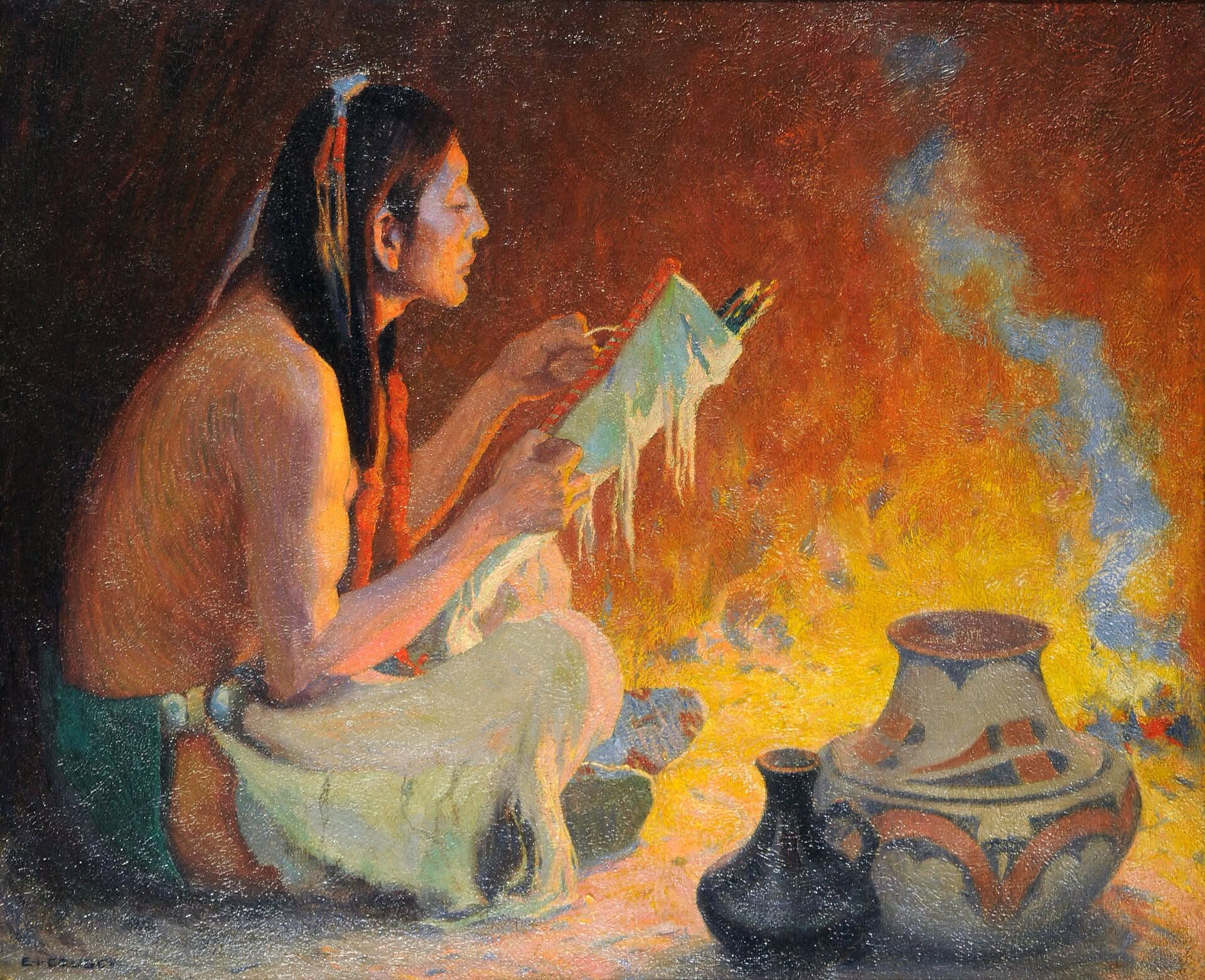
Couse worked in several genres, including landscape, portraiture, and carefully arranged scenes featuring Native American models, particularly members of Taos Pueblo. Working primarily in oil on canvas, he combined the academic draftsmanship acquired in Europe with warm colors and carefully controlled effects of natural and artificial light. Sunlight and firelight frequently play important roles in his compositions, creating contrasts between illuminated and shadowed areas while emphasizing the forms of his figures.
In many of Couse's paintings, figures are positioned against adobe walls, within mountainous landscapes, or inside dimly lit interiors. These settings provide a clearly organized spatial structure in which the human figure and surrounding environment are connected through light, color, and form.
Another notable feature of Couse's work is his attention to material surfaces. Textiles, pottery, leather, and ceremonial objects are rendered with careful consideration of their textures and physical qualities. These details contribute not only to the visual richness of his compositions but also to the construction of the environments in which his figures appear.
In 1915, Couse became one of the six founding members of the Taos Society of Artists, an organization that brought together painters working in the Taos region and helped introduce the art and landscape of northern New Mexico to a wider American audience. Couse subsequently became the society's first president. The establishment of the organization coincided with the emergence of Taos as an important destination for American artists during the early twentieth century.
Through his paintings of the landscapes and people of Taos, Couse helped bring northern New Mexico and its developing artistic community to national attention. His work combined the academic painting techniques he had learned in Europe with subjects drawn from the landscapes and communities of the American Southwest.
Couse died in Albuquerque in 1936, after more than three decades of artistic activity associated with Taos. His name remains closely connected with the early development of the Taos art colony and the regional painting tradition that emerged in northern New Mexico during the first decades of the twentieth century.
Within the history of American art, Couse represents a generation of artists who traveled toward the American West and Southwest in search of subjects beyond the established artistic centers of the East Coast. His academic training, interest in the human figure, and long engagement with Taos enabled him to develop a body of work that brought together European academic technique with the landscapes, people, and visual culture of New Mexico. His paintings consequently became an important part of the history of the Taos artistic community and the development of a distinctive regional tradition in American painting.
See more here
Eanger Irving Couse was born in 1866 in Saginaw, Michigan, United States. He began his artistic training at the Art Institute of Chicago before traveling to Paris to continue his studies at the Académie Julian, one of the leading private art schools in France during the late nineteenth century. There, Couse studied under William-Adolphe Bouguereau and other academic painters, developing a strong foundation in figure drawing and a disciplined approach to the study of the human form.
After returning to the United States, Couse traveled extensively in search of subjects and new sources of inspiration. Beginning in 1902, he spent extended periods in Taos, New Mexico, a region that would become central to his artistic career. The landscape, Native American communities, and daily life of Taos gradually became recurring subjects throughout much of his work.
Couse worked in several genres, including landscape, portraiture, and carefully arranged scenes featuring Native American models, particularly members of Taos Pueblo. Working primarily in oil on canvas, he combined the academic draftsmanship acquired in Europe with warm colors and carefully controlled effects of natural and artificial light. Sunlight and firelight frequently play important roles in his compositions, creating contrasts between illuminated and shadowed areas while emphasizing the forms of his figures.
In many of Couse's paintings, figures are positioned against adobe walls, within mountainous landscapes, or inside dimly lit interiors. These settings provide a clearly organized spatial structure in which the human figure and surrounding environment are connected through light, color, and form.
Another notable feature of Couse's work is his attention to material surfaces. Textiles, pottery, leather, and ceremonial objects are rendered with careful consideration of their textures and physical qualities. These details contribute not only to the visual richness of his compositions but also to the construction of the environments in which his figures appear.
In 1915, Couse became one of the six founding members of the Taos Society of Artists, an organization that brought together painters working in the Taos region and helped introduce the art and landscape of northern New Mexico to a wider American audience. Couse subsequently became the society's first president. The establishment of the organization coincided with the emergence of Taos as an important destination for American artists during the early twentieth century.
Through his paintings of the landscapes and people of Taos, Couse helped bring northern New Mexico and its developing artistic community to national attention. His work combined the academic painting techniques he had learned in Europe with subjects drawn from the landscapes and communities of the American Southwest.
Couse died in Albuquerque in 1936, after more than three decades of artistic activity associated with Taos. His name remains closely connected with the early development of the Taos art colony and the regional painting tradition that emerged in northern New Mexico during the first decades of the twentieth century.
Within the history of American art, Couse represents a generation of artists who traveled toward the American West and Southwest in search of subjects beyond the established artistic centers of the East Coast. His academic training, interest in the human figure, and long engagement with Taos enabled him to develop a body of work that brought together European academic technique with the landscapes, people, and visual culture of New Mexico. His paintings consequently became an important part of the history of the Taos artistic community and the development of a distinctive regional tradition in American painting.
See more here