- Joined
- 20/7/24
- Bài viết
- 4,308
- Reaction score
- 0
- Points
- 36
John Martin – The Visionary Painter of Monumental Landscapes and Romantic Imagination
John Martin was one of the most remarkable British painters of the Romantic era, celebrated for his monumental compositions that combined architectural grandeur, biblical narratives, and dramatic landscapes. His paintings transformed familiar religious and historical subjects into awe inspiring spectacles, distinguished by their immense scale, theatrical lighting, and extraordinary attention to architectural detail. Through his imaginative vision, Martin expanded the possibilities of historical painting and became one of the most widely admired artists of nineteenth century Britain.
John Martin was born in 1789 in Haydon Bridge. Unlike many of his contemporaries who received formal academic training, Martin's path to becoming an artist was largely unconventional. After moving to London, he worked as an apprentice to a coach decorator, where he developed exceptional skills in perspective, ornamentation, and architectural design. Largely self taught as a painter, he gradually cultivated an ambitious artistic style that blended technical precision with an extraordinary sense of imagination.
Martin's breakthrough came through his monumental biblical and historical paintings, which quickly attracted the attention of Victorian audiences. At a time when Romanticism encouraged artists to explore emotion, spirituality, and the sublime, Martin distinguished himself by presenting familiar narratives on an unprecedented scale. By the 1820s, he had become one of Britain's most celebrated Romantic painters, admired not only for his technical mastery but also for his ability to create overwhelming visual experiences.
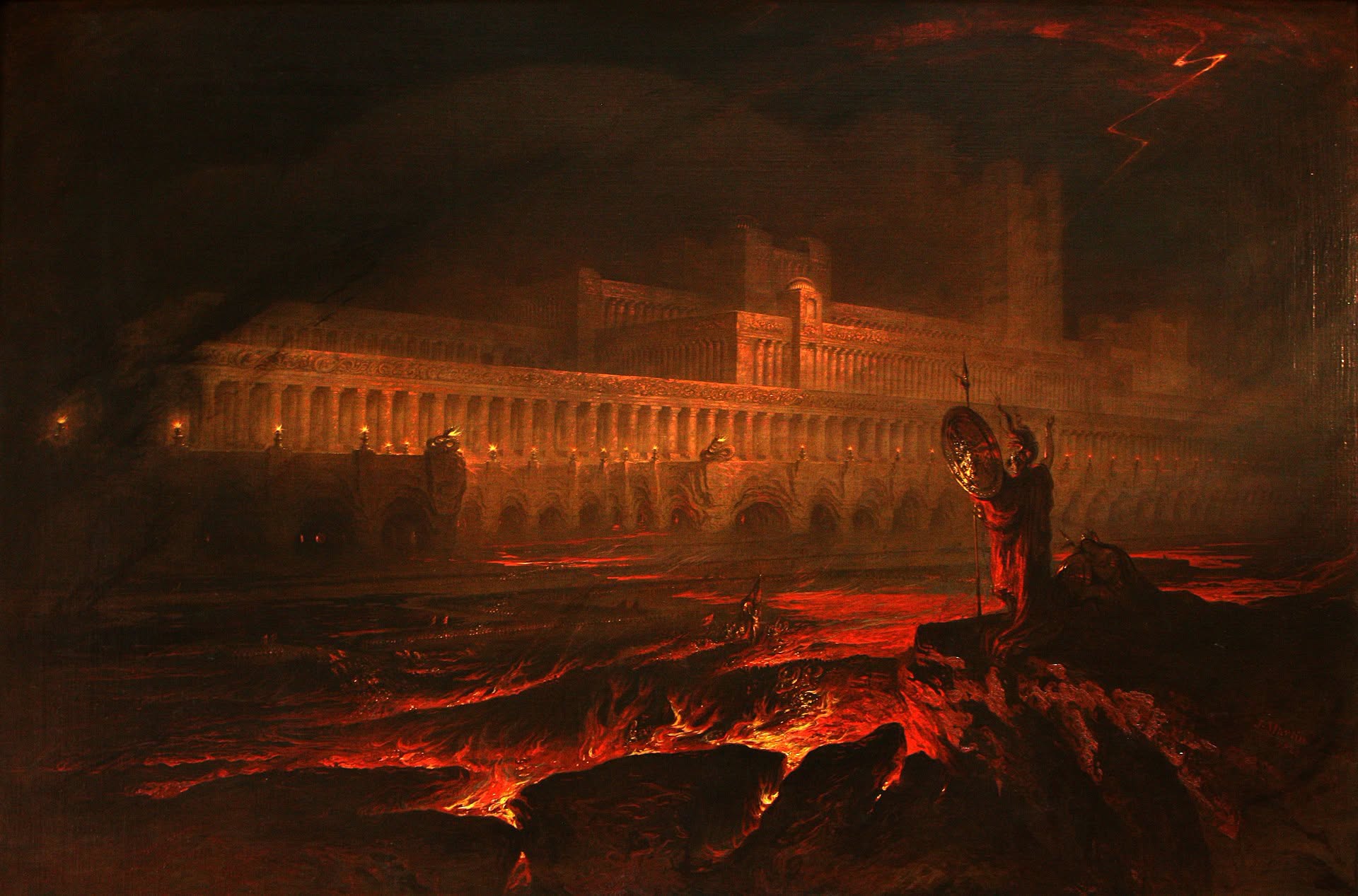
One of the defining characteristics of Martin's art is his remarkable treatment of space and architecture. His paintings frequently depict vast ancient cities, colossal temples, immense palaces, and apocalyptic landscapes in which human figures appear almost insignificant against monumental surroundings. Carefully calculated perspectives guide the viewer's eye through enormous architectural spaces, creating a profound sense of depth and grandeur. Every composition is meticulously organized, allowing the immense scale of his imagined worlds to dominate the visual experience while maintaining remarkable structural clarity.
Martin worked primarily in oil on canvas, though he also achieved considerable success as a master of mezzotint engraving. His command of light and shadow became one of the defining features of his artistic language. Brilliant rays of sunlight breaking through storm clouds, distant fires illuminating dark landscapes, and glowing horizons emerging from destruction all contribute to an atmosphere of overwhelming drama. Rather than serving merely as illumination, light becomes an essential narrative element that directs emotion, reinforces symbolism, and magnifies the sense of divine power present in many of his compositions.
His subject matter reflects the central concerns of Romanticism. Martin was deeply fascinated by biblical history, ancient civilizations, natural catastrophe, and the rise and fall of empires. His paintings often explore moments of divine judgment, human ambition, and the fragility of civilization in the face of forces beyond human control. These themes resonated strongly with nineteenth century audiences, who viewed his dramatic visions as both moral allegories and spectacular artistic achievements.
Beyond painting, Martin was also an accomplished printmaker whose mezzotint engravings played a crucial role in spreading his reputation across Europe and North America. These prints reproduced his monumental compositions with remarkable richness and allowed a much wider audience to experience his artistic vision. At a time when original paintings were accessible to relatively few collectors, his engravings helped establish him as an internationally recognized artist.
John Martin died in 1854 on the Isle of Man, leaving behind a body of work that continues to fascinate historians, architects, and art enthusiasts alike. His paintings remain celebrated for their extraordinary imagination, architectural sophistication, and breathtaking sense of scale. Today, Martin is regarded not only as one of the leading figures of British Romanticism but also as an artist whose visionary landscapes anticipated the visual language of modern fantasy, cinema, and epic historical illustration. His legacy endures through works that continue to inspire awe with their powerful combination of imagination, technical mastery, and monumental ambition.
See more here
John Martin was one of the most remarkable British painters of the Romantic era, celebrated for his monumental compositions that combined architectural grandeur, biblical narratives, and dramatic landscapes. His paintings transformed familiar religious and historical subjects into awe inspiring spectacles, distinguished by their immense scale, theatrical lighting, and extraordinary attention to architectural detail. Through his imaginative vision, Martin expanded the possibilities of historical painting and became one of the most widely admired artists of nineteenth century Britain.
John Martin was born in 1789 in Haydon Bridge. Unlike many of his contemporaries who received formal academic training, Martin's path to becoming an artist was largely unconventional. After moving to London, he worked as an apprentice to a coach decorator, where he developed exceptional skills in perspective, ornamentation, and architectural design. Largely self taught as a painter, he gradually cultivated an ambitious artistic style that blended technical precision with an extraordinary sense of imagination.
Martin's breakthrough came through his monumental biblical and historical paintings, which quickly attracted the attention of Victorian audiences. At a time when Romanticism encouraged artists to explore emotion, spirituality, and the sublime, Martin distinguished himself by presenting familiar narratives on an unprecedented scale. By the 1820s, he had become one of Britain's most celebrated Romantic painters, admired not only for his technical mastery but also for his ability to create overwhelming visual experiences.
One of the defining characteristics of Martin's art is his remarkable treatment of space and architecture. His paintings frequently depict vast ancient cities, colossal temples, immense palaces, and apocalyptic landscapes in which human figures appear almost insignificant against monumental surroundings. Carefully calculated perspectives guide the viewer's eye through enormous architectural spaces, creating a profound sense of depth and grandeur. Every composition is meticulously organized, allowing the immense scale of his imagined worlds to dominate the visual experience while maintaining remarkable structural clarity.
Martin worked primarily in oil on canvas, though he also achieved considerable success as a master of mezzotint engraving. His command of light and shadow became one of the defining features of his artistic language. Brilliant rays of sunlight breaking through storm clouds, distant fires illuminating dark landscapes, and glowing horizons emerging from destruction all contribute to an atmosphere of overwhelming drama. Rather than serving merely as illumination, light becomes an essential narrative element that directs emotion, reinforces symbolism, and magnifies the sense of divine power present in many of his compositions.
His subject matter reflects the central concerns of Romanticism. Martin was deeply fascinated by biblical history, ancient civilizations, natural catastrophe, and the rise and fall of empires. His paintings often explore moments of divine judgment, human ambition, and the fragility of civilization in the face of forces beyond human control. These themes resonated strongly with nineteenth century audiences, who viewed his dramatic visions as both moral allegories and spectacular artistic achievements.
Beyond painting, Martin was also an accomplished printmaker whose mezzotint engravings played a crucial role in spreading his reputation across Europe and North America. These prints reproduced his monumental compositions with remarkable richness and allowed a much wider audience to experience his artistic vision. At a time when original paintings were accessible to relatively few collectors, his engravings helped establish him as an internationally recognized artist.
John Martin died in 1854 on the Isle of Man, leaving behind a body of work that continues to fascinate historians, architects, and art enthusiasts alike. His paintings remain celebrated for their extraordinary imagination, architectural sophistication, and breathtaking sense of scale. Today, Martin is regarded not only as one of the leading figures of British Romanticism but also as an artist whose visionary landscapes anticipated the visual language of modern fantasy, cinema, and epic historical illustration. His legacy endures through works that continue to inspire awe with their powerful combination of imagination, technical mastery, and monumental ambition.
See more here