- Joined
- 20/7/24
- Bài viết
- 4,107
- Reaction score
- 0
- Points
- 36
Léon Maxime Faivre – The French Painter Who Brought History and Humanity’s Primitive Instincts into Art
Léon Maxime Faivre was one of the most compelling French painters of the late nineteenth and early twentieth centuries, recognized for his ability to combine academic painting with a profound sense of storytelling shaped by history and anthropology. Born in Paris in 1856, he developed as an artist during a period when the French capital stood at the center of the European art world. While deeply rooted in the artistic culture of Paris, Faivre’s paintings reached far beyond the city itself, exploring larger themes such as history, human nature, and the origins of civilization.
Faivre belonged to a generation of artists trained within the French academic tradition, where technical mastery and formal discipline were highly valued. At a time when artistic societies played a decisive role in building reputations, he entered the influential circle of the Société des Artistes Français under the guidance of Jean Léon Gérôme, one of the most respected academic painters of the era. This marked an important turning point in his career, as the society’s annual Salons in Paris offered artists a prestigious platform to present new works to critics and the public. Through these exhibitions, Faivre gradually established himself within the artistic landscape of his time.
One of the defining features of Léon Maxime Faivre’s career was the remarkable diversity of his subjects. He did not confine himself to a single genre but explored allegorical painting, portraiture, landscapes, still life, and historical scenes with equal dedication. This versatility reflected both his technical command and his intellectual curiosity. His paintings consistently reveal an artist interested not only in visual composition but also in narrative and the emotional experience behind every subject.
Works such as The Death of Princess Lamballe and Two Mothers clearly demonstrate Faivre’s talent for visual storytelling. He rarely painted a scene as a simple historical or emotional record. Instead, he created compositions charged with atmosphere and dramatic tension, allowing viewers to sense the events unfolding beyond the frame. His figures often appear in moments of vulnerability, grief, fear, or emotional conflict, and it is through these states that he created such a powerful psychological presence. The viewer is not simply observing a painting but is drawn into the emotional narrative it contains.
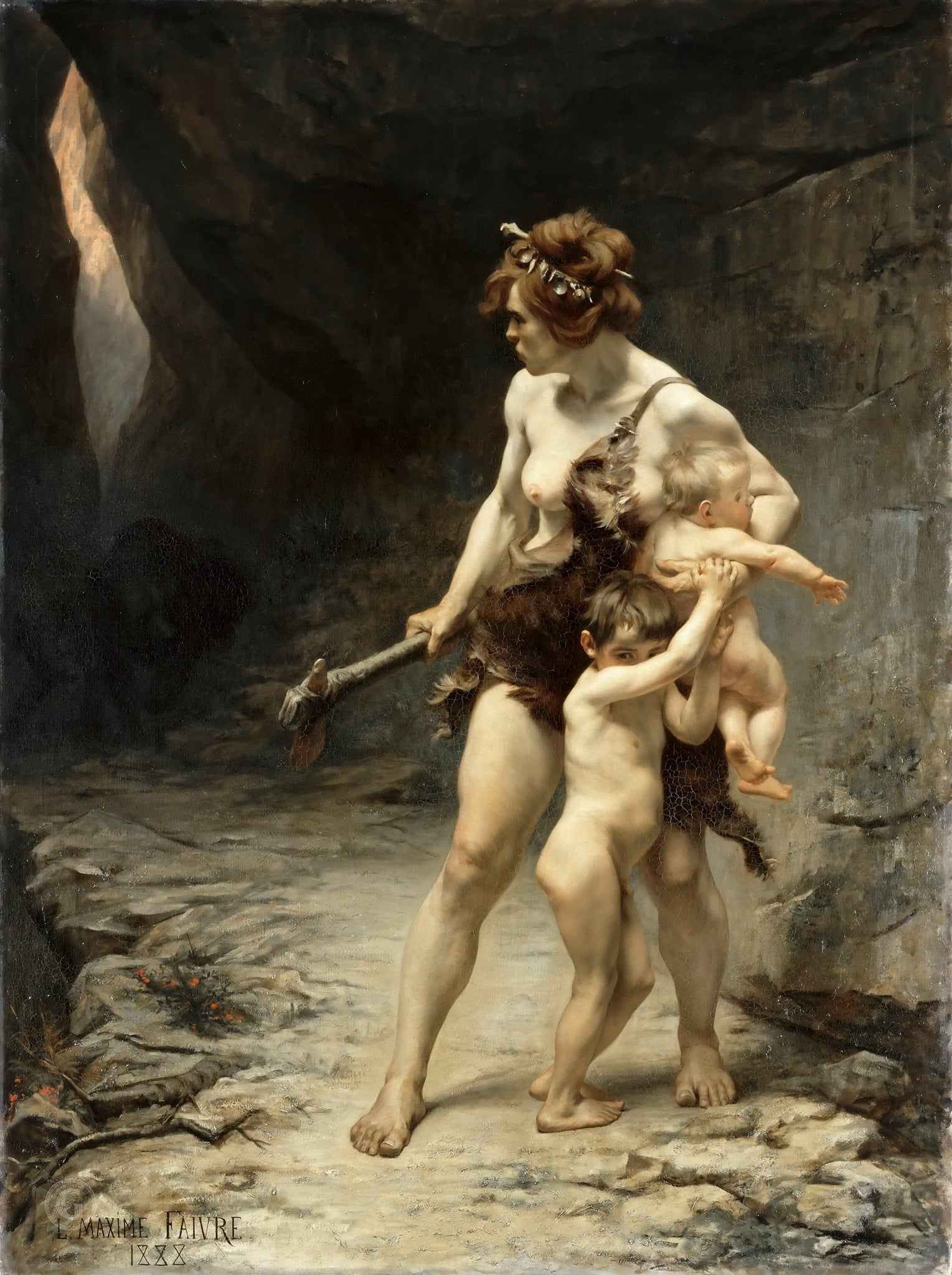
Perhaps the most distinctive and memorable part of Faivre’s artistic legacy lies in his series dedicated to prehistoric life. This was an unusual subject within French painting of the period and reveals a particularly strong interest in anthropology and early human civilization. In these works, Faivre imagined humanity at its most primitive stage, surrounded by the raw and often brutal realities of nature. Rather than idealizing prehistoric life, he portrayed it as a world shaped by danger, instinct, and survival.
Many of these paintings are filled with cinematic intensity. One depicts a prehistoric mother urgently pulling her children away from an unseen threat. Another shows a family hiding while preparing to hunt a bear. In another dramatic scene, two men fight to the death while a woman and child stand nearby, visibly distressed and fearful. These compositions are visually powerful, but their deeper significance lies in what they suggest about the human condition. Fear, protection, violence, survival, and family bonds appear not as modern experiences but as instincts embedded in humanity since the earliest beginnings.
What makes Léon Maxime Faivre especially intriguing is that, despite the richness of his artistic legacy, relatively little is known about his personal life. Historical documentation surrounding him remains limited, and many details about his life outside the studio were never widely recorded. As a result, his paintings themselves have become the most enduring expression of who he was as an artist. Through them, his interests, imagination, and worldview continue to speak across time.
Viewed as a whole, Léon Maxime Faivre represents a remarkable example of the French academic painter who remained grounded in classical technique while pushing the boundaries of subject matter and narrative imagination. His art bridges history, anthropology, and emotional realism, transforming distant moments of the past into vivid and compelling visual experiences. The enduring strength of his work lies in this ability to connect historical imagination with universal human emotion, allowing scenes from another time to remain powerful and relevant to viewers today.
See more here
Léon Maxime Faivre was one of the most compelling French painters of the late nineteenth and early twentieth centuries, recognized for his ability to combine academic painting with a profound sense of storytelling shaped by history and anthropology. Born in Paris in 1856, he developed as an artist during a period when the French capital stood at the center of the European art world. While deeply rooted in the artistic culture of Paris, Faivre’s paintings reached far beyond the city itself, exploring larger themes such as history, human nature, and the origins of civilization.
Faivre belonged to a generation of artists trained within the French academic tradition, where technical mastery and formal discipline were highly valued. At a time when artistic societies played a decisive role in building reputations, he entered the influential circle of the Société des Artistes Français under the guidance of Jean Léon Gérôme, one of the most respected academic painters of the era. This marked an important turning point in his career, as the society’s annual Salons in Paris offered artists a prestigious platform to present new works to critics and the public. Through these exhibitions, Faivre gradually established himself within the artistic landscape of his time.
One of the defining features of Léon Maxime Faivre’s career was the remarkable diversity of his subjects. He did not confine himself to a single genre but explored allegorical painting, portraiture, landscapes, still life, and historical scenes with equal dedication. This versatility reflected both his technical command and his intellectual curiosity. His paintings consistently reveal an artist interested not only in visual composition but also in narrative and the emotional experience behind every subject.
Works such as The Death of Princess Lamballe and Two Mothers clearly demonstrate Faivre’s talent for visual storytelling. He rarely painted a scene as a simple historical or emotional record. Instead, he created compositions charged with atmosphere and dramatic tension, allowing viewers to sense the events unfolding beyond the frame. His figures often appear in moments of vulnerability, grief, fear, or emotional conflict, and it is through these states that he created such a powerful psychological presence. The viewer is not simply observing a painting but is drawn into the emotional narrative it contains.
Perhaps the most distinctive and memorable part of Faivre’s artistic legacy lies in his series dedicated to prehistoric life. This was an unusual subject within French painting of the period and reveals a particularly strong interest in anthropology and early human civilization. In these works, Faivre imagined humanity at its most primitive stage, surrounded by the raw and often brutal realities of nature. Rather than idealizing prehistoric life, he portrayed it as a world shaped by danger, instinct, and survival.
Many of these paintings are filled with cinematic intensity. One depicts a prehistoric mother urgently pulling her children away from an unseen threat. Another shows a family hiding while preparing to hunt a bear. In another dramatic scene, two men fight to the death while a woman and child stand nearby, visibly distressed and fearful. These compositions are visually powerful, but their deeper significance lies in what they suggest about the human condition. Fear, protection, violence, survival, and family bonds appear not as modern experiences but as instincts embedded in humanity since the earliest beginnings.
What makes Léon Maxime Faivre especially intriguing is that, despite the richness of his artistic legacy, relatively little is known about his personal life. Historical documentation surrounding him remains limited, and many details about his life outside the studio were never widely recorded. As a result, his paintings themselves have become the most enduring expression of who he was as an artist. Through them, his interests, imagination, and worldview continue to speak across time.
Viewed as a whole, Léon Maxime Faivre represents a remarkable example of the French academic painter who remained grounded in classical technique while pushing the boundaries of subject matter and narrative imagination. His art bridges history, anthropology, and emotional realism, transforming distant moments of the past into vivid and compelling visual experiences. The enduring strength of his work lies in this ability to connect historical imagination with universal human emotion, allowing scenes from another time to remain powerful and relevant to viewers today.
See more here