- Joined
- 20/7/24
- Bài viết
- 4,088
- Reaction score
- 0
- Points
- 36
Slava of the Arctic: A Man Living in Frozen Time and at the Frontier of Memory
Slava of the Arctic: the Extreme Weatherman Living in a Timewarp by Russian photographer Evgenia Arbugaeva is a profound visual inquiry into human existence, time, and solitude in the polar frontier. The central figure of the series is Slava, a meteorologist working at one of the most remote Arctic weather stations, a place where modern life feels suspended and time seems to have slowed to a near standstill.
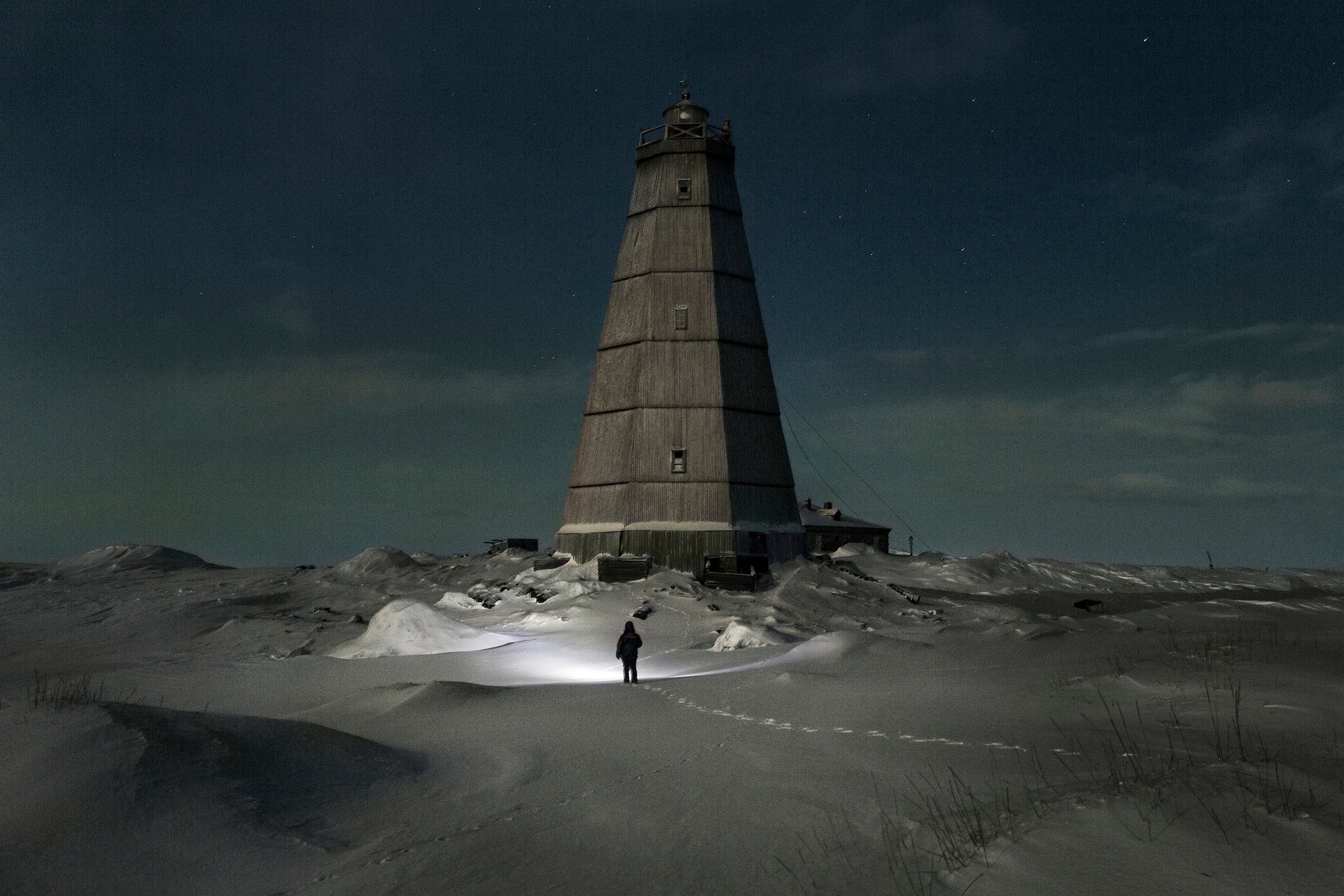
Slava lives at the Khodovarikha weather station, an outpost defined by extreme climatic conditions and prolonged isolation. His work is scientific and technical, involving the measurement of temperature, precipitation, and wind, and the transmission of meteorological data via Morse code - a technology long obsolete in most parts of the contemporary world. Arbugaeva depicts his living quarters as a “living museum” of the Soviet era: newspaper clippings of Yuri Gagarin from 1961, wallpaper from another decade, and aging communication equipment. This environment creates the sensation of a world detached from contemporary historical progression, where personal and collective memory merge into a single temporal layer.
Evgenia Arbugaeva, who was born in Yakutia and grew up in a similar northern landscape, brings an intimate understanding of polar darkness and geographic isolation to the project. This background enables her to approach Slava not merely as a subject, but as a symbolic embodiment of the Arctic itself. She lived with him for more than two weeks, documenting his daily routines and capturing moments that are both ordinary and deeply symbolic. As Arbugaeva noted, Slava does not simply inhabit this place - he is this place, an individual whose identity is inseparable from the environment he occupies.
Visually, the series relies on natural light under extreme conditions, particularly during winter, when darkness dominates the landscape. This creates an almost surreal atmosphere, in which the human figure becomes the only anchor in an endless expanse of snow, ice, and night. Images of Slava in his modest interior, surrounded by relics of Soviet space culture and technological optimism, evoke reflections on the persistence of memory and identity in a rapidly changing world.
Beyond its documentary value, the project functions as a meditation on time and modernity. Slava represents a generation and a value system that is gradually disappearing - one shaped by scientific duty, state service, and faith in technological progress within a collective ideal. In the era of globalization and digital acceleration, he appears as a temporal anomaly, existing at the margins of contemporary history while preserving a fragment of twentieth-century memory.
In her broader career, Evgenia Arbugaeva is recognized for a poetic documentary style that fuses anthropology, personal memory, and cinematic aesthetics. She has received international recognition, including major photography awards, and her projects frequently explore the North, post-Soviet spaces, and individuals living at geographical or social margins. Through these narratives, she interrogates themes of identity, memory, and human presence in extreme environments.
Slava of the Arctic is therefore more than a portrait series; it is a visual essay on human endurance, solitude as an existential condition, and memory as a parallel mode of existence. Slava is not merely an elderly meteorologist in the Arctic - he is a living witness to history, a symbol of frozen time, and a reminder that even in the most remote corners of the world, human experience remains the core of every story.
See more here
Slava of the Arctic: the Extreme Weatherman Living in a Timewarp by Russian photographer Evgenia Arbugaeva is a profound visual inquiry into human existence, time, and solitude in the polar frontier. The central figure of the series is Slava, a meteorologist working at one of the most remote Arctic weather stations, a place where modern life feels suspended and time seems to have slowed to a near standstill.
Slava lives at the Khodovarikha weather station, an outpost defined by extreme climatic conditions and prolonged isolation. His work is scientific and technical, involving the measurement of temperature, precipitation, and wind, and the transmission of meteorological data via Morse code - a technology long obsolete in most parts of the contemporary world. Arbugaeva depicts his living quarters as a “living museum” of the Soviet era: newspaper clippings of Yuri Gagarin from 1961, wallpaper from another decade, and aging communication equipment. This environment creates the sensation of a world detached from contemporary historical progression, where personal and collective memory merge into a single temporal layer.
Evgenia Arbugaeva, who was born in Yakutia and grew up in a similar northern landscape, brings an intimate understanding of polar darkness and geographic isolation to the project. This background enables her to approach Slava not merely as a subject, but as a symbolic embodiment of the Arctic itself. She lived with him for more than two weeks, documenting his daily routines and capturing moments that are both ordinary and deeply symbolic. As Arbugaeva noted, Slava does not simply inhabit this place - he is this place, an individual whose identity is inseparable from the environment he occupies.
Visually, the series relies on natural light under extreme conditions, particularly during winter, when darkness dominates the landscape. This creates an almost surreal atmosphere, in which the human figure becomes the only anchor in an endless expanse of snow, ice, and night. Images of Slava in his modest interior, surrounded by relics of Soviet space culture and technological optimism, evoke reflections on the persistence of memory and identity in a rapidly changing world.
Beyond its documentary value, the project functions as a meditation on time and modernity. Slava represents a generation and a value system that is gradually disappearing - one shaped by scientific duty, state service, and faith in technological progress within a collective ideal. In the era of globalization and digital acceleration, he appears as a temporal anomaly, existing at the margins of contemporary history while preserving a fragment of twentieth-century memory.
In her broader career, Evgenia Arbugaeva is recognized for a poetic documentary style that fuses anthropology, personal memory, and cinematic aesthetics. She has received international recognition, including major photography awards, and her projects frequently explore the North, post-Soviet spaces, and individuals living at geographical or social margins. Through these narratives, she interrogates themes of identity, memory, and human presence in extreme environments.
Slava of the Arctic is therefore more than a portrait series; it is a visual essay on human endurance, solitude as an existential condition, and memory as a parallel mode of existence. Slava is not merely an elderly meteorologist in the Arctic - he is a living witness to history, a symbol of frozen time, and a reminder that even in the most remote corners of the world, human experience remains the core of every story.
See more here